
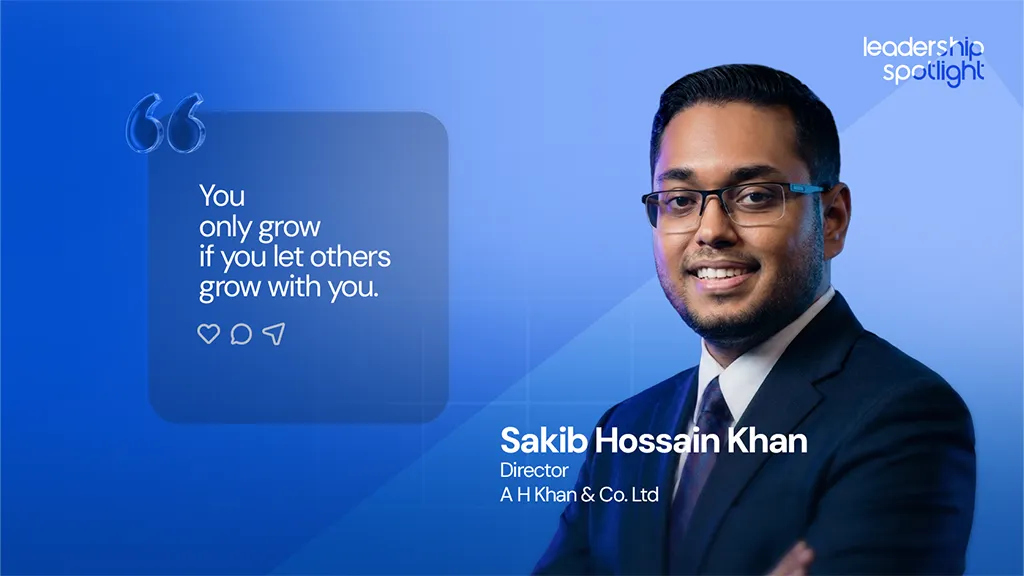
A conversation with the Director of A H Khan & Co. Ltd. about what really matters in leadership
In Bangladesh's fast-paced logistics industry, we often hear about leadership in terms of targets, deadlines, and bottom lines. But when we sat down with Sakib Hossain Khan, Director at A H Khan & Co. Ltd., we heard something different.
His leadership philosophy? "You only grow if you let others grow with you."
It's a simple idea, but one that many leaders forget as they climb higher. We spent time understanding what this actually means in practice.
Growth Isn't a Solo Journey
When Khan talks about growing together with your team, he's not speaking in abstracts. In logistics and supply chain management, where every day brings new challenges - delayed shipments, documentation issues, last-minute client requests - a leader can't solve everything alone.
"If you're the only person making decisions, you're not building a team," Khan explains. "You're building a dependency."
The difference matters. When leaders invest time in developing their team members' judgment and problem-solving skills, they're not just being kind - they're building a more resilient organization. One where operations don't grind to a halt when the leader isn't available.
Think of it this way: if your business can't function smoothly without you, you haven't built a business - you've built yourself a demanding job.
The One Quality That Matters Most
We asked Khan what he looks for when hiring new team members. His answer was clear: “A proactive mindset.”
"You can teach someone technical skills," he says. "But you can't teach someone to care about solving problems before they're asked."
In his experience, the difference between reactive and proactive employees shapes everything. A reactive person waits for instructions. A proactive person sees a problem coming and handles it.
Here's a real example from logistics:
When a shipment faces documentation issues at customs, a reactive employee reports: "Sir, there's a problem. What should we do?"
A proactive employee acts: "Sir, I've identified the documentation gap, contacted our broker, and arranged the missing paperwork. We'll have a six-hour delay instead of two days. Should I update the client?"
One creates more work for the leader. The other creates solutions.
This is why Mr. Sakib prioritizes mindset over credentials when hiring. Skills can be trained. Attitude toward work? That comes from within.
Two Mistakes That Hurt Teams
When we asked what managers should stop doing, Mr. Sakib didn't hesitate: "Hiring the wrong people and not giving proper recognition."
The Cost of Bad Hires
In Bangladesh's business environment, there's often pressure to fill positions quickly. But Khan has learned that hiring the wrong person costs more than leaving a position temporarily empty.
A bad hire doesn't just underperform - they affect everyone. In logistics, where coordination is everything, one weak link means the whole team has to compensate. The warehouse team works with incomplete information. The delivery team scrambles. Customer service handles complaints.
"One wrong hire becomes a tax that the entire team pays,"
The Power of Recognition
The second mistake - failing to recognize good work is quieter but equally damaging.
Recognition doesn't mean grand gestures or expensive rewards. It means acknowledging when someone goes beyond the call of duty. When someone prevents a problem. When someone takes initiative.
"When people feel their extra effort is invisible, they stop giving it,"
The Lesson from His Biggest Regret
Every leader has regrets, and Mr. Sakib is honest about his: not implementing proper Standard Operating Procedures (SOPs) earlier in his career.
"I thought SOPs were just corporate bureaucracy," he admits. "I learned the hard way that they're what separate efficiency from chaos."
Why SOPs Actually Matter
Without clear procedures, everything lives in someone's head. Knowledge isn't shared - it's hoarded. New employees take months to get up to speed. Mistakes repeat because lessons aren't captured. And if a key person leaves? That knowledge walks out the door with them.
With SOPs in place, processes become teachable. New hires learn faster. Teams execute consistently. And when someone discovers a better way to do something, that improvement gets documented for everyone.
"SOPs don't slow you down. They speed you up by eliminating confusion about routine tasks. Your team stops wondering 'how do I do this?' and starts focusing on 'how can I do this better?'"
For a logistics operation where documentation accuracy, timing, and coordination determine success - having clear procedures isn't optional. It's the foundation.
The Habit That Keeps Leaders Growing
We asked him what keeps him improving in his field. His answer was refreshingly simple: "Being humble enough to learn every day."
In an industry that's constantly evolving - new technologies, changing regulations, shifting customer expectations - leaders who stop learning become obstacles.
But his humility isn't about lacking confidence. It's about staying curious.
"I ask questions, even when I'm the senior person in the room," he says. "I learn from my team members, regardless of their position. When something surprises me, I ask myself what it reveals about my assumptions."
This approach creates something valuable: psychological safety. When the leader admits they don't know everything, team members feel comfortable sharing ideas, raising concerns, and experimenting with new approaches.
The result? Organizations where everyone learns, not just the person at the top.
Advice for the Next Generation
When we asked him what he'd tell emerging business leaders, his answer brought together everything we'd discussed:
"Learn to be humble and have clarity and confidence in decision-making."
It sounds like a contradiction how can you be both humble and confident? But Khan explains it's actually the key.
Humility means staying open to learning. Seeking input. Admitting mistakes. Acknowledging what you don't know. Confidence means making clear decisions once you've gathered information. Taking ownership. Providing direction when your team needs it.
"You don't need all the answers to lead effectively," He says. "You need the humility to find answers and the confidence to act on them."
For young leaders in Bangladesh's business environment where relationships matter, where trust is built over time, where respect for experience runs deep - this balance is especially important.
Be humble enough that your team trusts you're learning alongside them. Be confident enough that they trust you can lead them through uncertainty.
Looking Ahead
We asked Mr. Sakib for his prediction about the logistics industry over the next five years. His answer was straightforward: "More competition will grow."
What does that mean for businesses?
Operational excellence becomes non-negotiable. The companies that thrive won't necessarily be the cheapest - they'll be the most reliable, most efficient, and most innovative.
And the differentiator? The quality of your people and systems.
Technology is available to everyone. Processes can be copied. But a team culture built on proactive ownership, continuous learning, and clear systems? That's much harder to replicate.
Key Takeaways
Here's what we learned from Sakib Hossain Khan:
Invest in your team's growth. Your success is tied to theirs. Build their capabilities, don't create dependency on yourself.
Hire for attitude, train for skills. A proactive mindset is what you can't teach. Everything else comes with training and experience.
Recognize good work consistently. Acknowledgment doesn't cost money, but its absence costs talent.
Build systems early. SOPs aren't bureaucracy - they're the scaffolding that lets you scale without chaos.
Stay humble, stay learning. The leaders who adapt are those who never stop being curious about how things can improve.
Balance humility with confidence. Learn from everyone, but decide clearly when decisions are needed.
About Leadership Spotlight
Leadership Spotlight is Notionhive's interview series featuring business leaders across different industries in Bangladesh. We explore the practical wisdom, honest lessons and real experiences that shape how successful leaders build teams and drive growth.

About Author
Tanzim Sarwar TazTanzim Sarwar Taz is a content writer with 7+ years of experience creating in-depth content on SEO, technology, web development trends, and AI-driven search. His work focuses on emerging topics such as AEO, GEO, search experience optimization, artificial intelligence, and modern web technologies, delivering practical insights backed by research and industry developments.